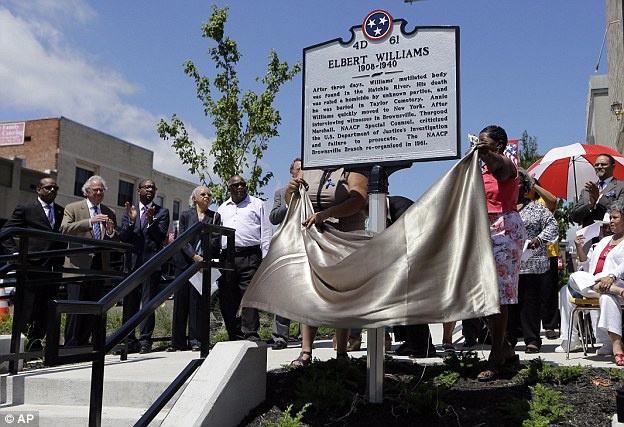
Fourteen years ago, Jim Emison began a mission to find out who killed a man believed to be the first NAACP activist slain for trying to register black voters. As a new year begins, the retired 82-year-old white attorney is still on the case, and he’s also making sure that Elbert Williams is not forgotten.
Emison recently talked about his efforts during a lecture at Vanderbilt University, his alma mater. He said he’s currently working on the establishment of an Elbert Williams Interpretive Center in Brownsville, Tennessee, modeled on the Emmett Till Interpretive Center in Sumner, Mississippi. Williams, who was slain in Brownsville on June 20, 1940, was martyred for civil rights long before NAACP leader Medgar Evers was gunned down by a Klansman outside his Jackson, Mississippi, home in 1963.
“We want to have a museum with a multi-media exhibit that tells the story of what happened in Brownsville,” said Emison, whose book about Williams, Murder on the Hatchie: The NAACP’s First Martyr, is to be released later this year in October. “It will have educational programs, especially for youth, about civil rights and voting rights. We want to do the same work that Elbert Williams was doing, registering people to vote, educating voters; getting them to exercise the right that was bought with his blood.”
In 2012, Emison was researching a story he planned to write about a court case when he came across an online article about Williams’ killing. Emison ordered FBI and Department of Justice case files from the U.S. National Archives.
The records showed that Brownsville police, upset because the local NAACP branch was registering blacks to vote, had led an effort to force its members out of town.
Some did leave, but Williams stayed behind. When the police got a tip that he was planning an NAACP meeting at his home, a group of men led by police officer Tip Hunter went to his residence, said they needed to question him outside and then took him away. Williams’ body was found three days later in the nearby Hatchie River.
No autopsy was performed. A coroner’s jury ruled the body was “decomposed so badly we could not make thorough examination” and that the cause of death was believed to be by “foul means by persons unknown.”
The Justice Department initially ordered the case presented to a federal grand jury, then mysteriously reversed itself and closed the case in early 1942. It did so in spite of evidence gathered by Thurgood Marshall, then special counsel to the NAACP, who went on to become the U.S. Supreme Court’s first African American justice in 1967.
“It was just like he was discarded; valueless, worthless,” Emison told The Associated Press in an interview in 2015.
Even though Williams was killed more than eighty years ago, Emison said following his lecture at Vanderbilt that efforts – though not overt –still exist to obstruct the voting process, particularly in the case of underrepresented groups. But he said that all of us, as voters, can help prevent such obstruction by voting the right people into office.
“It is our responsibility to see that Williams’ vision of an educated, active voter community is developed,” Emison said.
Carolina Kelly, a junior majoring in culture, advocacy, and leadership at Vanderbilt, was one of several students who attended Emison’s lecture. She said what resonated with her is that injustice can come in the form of “not doing anything,” and agrees that we as citizens are responsible for trying to put the right people in leadership positions who will do what’s right. She said that starts with community engagement and doing what we can to make a difference.
“Go to the local town hall meetings, city board meetings, court observation,” said Kelly, a Middle Tennessee native. “You get to see what’s happening in your community firsthand. You get to have direct feedback on what’s going on; so just really being present in your community, because you can be that change you want to see.”
The National Park Service is considering a national monument in Brownsville recognizing Williams. The NPS has scheduled a public comment meeting in March in Brownsville to discuss the matter.