



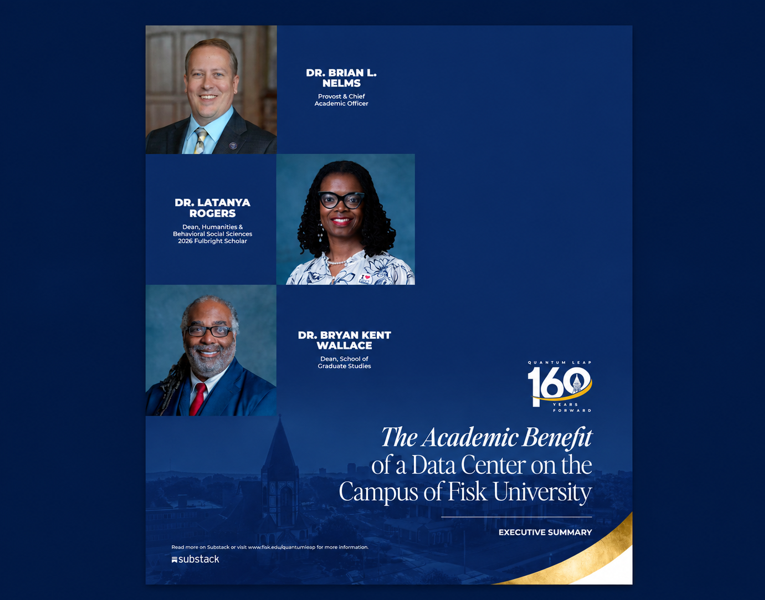

NASHVILLE — Fisk University released a white paper Wednesday outlining the academic benefits it says would come from its proposed on-campus data center. The paper provides new details about how students and faculty could use the facility while addressing environmental and community concerns that have fueled opposition to the project.
The paper, titled “The Academic Benefit of a Data Center on the Campus of Fisk University,” describes a proposed 100,000-square-foot, LEED-certified data center and academic hub on five acres at the south end of Fisk’s campus. The project would include a 30,000-square-foot educational center with classrooms, computer labs and collaborative spaces alongside a 70,000-square-foot, 30-megawatt data center.
It was authored by Dr. Brian L. Nelms, Fisk’s provost and chief academic officer; Dr. La Tanya Rogers, dean of Humanities & Behavioral Social Sciences and a 2026 Fulbright Scholar; and Dr. Bryan Kent Wallace, dean of the School of Graduate Studies.
The full report also provides more detail about the commercial arrangement envisioned for the data center.
Fisk says the 70,000-square-foot space housing the data center servers “will be leased to an external client (or clients) as tenants.”
The university says the tenants would occupy the facility while serving as a partner for Fisk and that it would seek “internships and employment opportunities for our students and the community” through the relationship.
The white paper also provides detailed explanations of how the facility would be incorporated into teaching and research. The data center would house a supercomputer controlled by the university and available to students and faculty for high-performance computing. Fisk says students could receive practical training in data center management, networking and cybersecurity through interaction with the data center tenant or a simulation lab in the academic hub. The university also identifies potential internships with the tenant and collaborating partners.
Faculty could use the computing resources for research ranging from brain-image analysis and molecular simulations to cybersecurity encryption, natural language processing and large language models, according to the paper. Fisk says the technology could support research not only in computer science, data science, mathematics, biology, physics and business but also in areas including social justice and digital humanities.
“Our goal of creating the next generation of leaders and scholars will require staying ahead and at the forefront of these technologies,” the university states in the report. Fisk argues that having its own data center would allow the university to provide access to technology to all students rather than relying solely on partnerships with outside institutions.
The white paper comes amid continued opposition to the data center from some Fisk alumni, students and North Nashville residents. Critics have raised concerns about noise, water and electricity consumption and the potential environmental impact on the surrounding community. The proposal has drawn protests and community meetings since it was unveiled in May as part of Fisk’s larger “Quantum Leap” campus redevelopment plan.
The HBCU directly addresses several of those concerns in the new paper. The university says the proposed center would use recirculating water for cooling rather than requiring what it describes as “massive water consumption.” It also says the building would be designed to limit noise and would connect to an existing 30-megawatt power line beneath university property.
Fisk further states that electricity would be obtained through regular commercial arrangements with Nashville Electric Service and the Tennessee Valley Authority and says residential customers “will not see any increases in rates nor reduced access to energy.”
The university also addresses concerns about locating the facility in North Nashville, noting that the proposed site is within a federally designated Qualified Opportunity Zone containing lower-income census tracts. Fisk distinguishes its proposal from data centers built by outside companies in lower-income communities, arguing that the university would manage the project on land it owns and could use the facility to create jobs, support workforce training and provide technology education to the surrounding community.
“The project will be grounded in the principles of academic and community benefit and sustainability,” Fisk states in the paper.
The university says the building would seek silver- or gold-level LEED certification and argues that the project could provide a model for developing data centers in ways that mitigate concerns about noise, water and power consumption.

1 Comment
Pingback: Gov. Bill Lee, Tennessee Cabinet Visit Fisk Amid Data Center Controversy – The Tennessee Tribune