


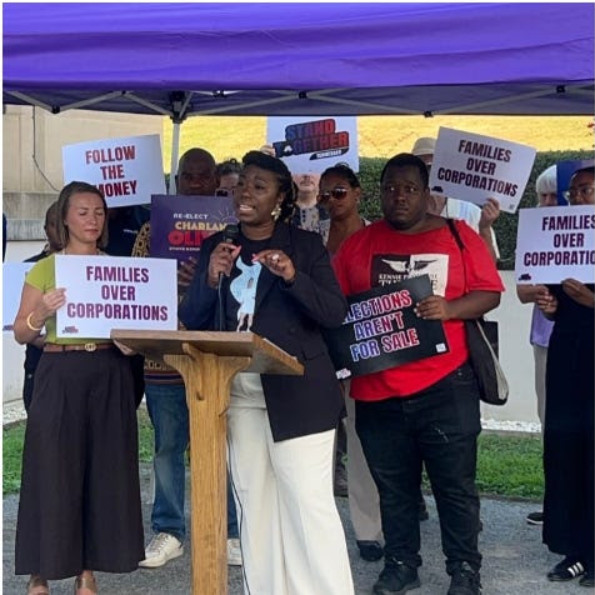

NASHVILLE — Sen. Charlane Oliver, D-Nashville, recently proposed anti-corruption legislation that would ban all corporate spending in state elections, saying big money-backed special interests have successfully rigged Tennessee’s state government to work for them while the needs of everyday families and communities have gone unmet.
The evidence of outsized corporate influence, Sen. Oliver says, is all over the Republican-controlled legislature’s record: billion-dollar tax breaks for big businesses, an unpopular private school voucher program, a disastrous private prison contract, private toll lanes, unnecessary data center tax breaks, increased loan rates and fees, as well as reduced protections for land, air and water.
“Corporations and billionaires have bought their way into Tennessee’s statehouse — bankrolling one-party rule in exchange for massive tax breaks, rigged rules and maps redrawn to keep them in power,” Oliver says. “Meanwhile, Tennessee families are facing rising grocery costs, unaffordable housing, underfunded schools and crumbling infrastructure. Let’s call the system what it is: rigged and corrupt.”
The problem traces back to the U.S. Supreme Court’s 2010 ruling in Citizens United v. FEC, which struck down limits on independent corporate political spending. In the years since, the Tennessee legislature has increased corporate donation limits and independent expenditures by outside, business-backed groups have exploded. A Tennessee family concerned about medical bills, childcare accessibility or public school funding does not believe they can compete with a CEO writing seven-figure checks, the Nashville lawmaker says.
An analysis of state campaign finance data puts numbers behind that imbalance. According to a review of the Tennessee Lookout’s Cash for Clout database, 75 of the top 100 donors to Tennessee state political campaigns over the last decade are businesses, business PACs or nonprofit corporations tied to special interest groups. Those 75 donors alone have poured $58 million into state campaigns since 2015. Another 16 of the remaining top 100 donors are political party or candidate PACs, most of which draw significant, if not majority, funding from those same corporate sources. And that $58 million tally reflects only direct campaign contributions — it does not include independent expenditures, which would add tens of millions more in corporate and dark money spending.
Inspired by the Center for American Progress’s Corporate Power Reset movement, Sen. Oliver will introduce the Restore Power to the People Act, legislation that bans corporations from spending in Tennessee state elections. The bill uses Tennessee’s constitutional authority to define what corporations are — and what powers they hold — to restrict election spending in Tennessee without waiting on Congress or the U.S. Supreme Court to act. Sen. Oliver says she will introduce the bill during the upcoming legislative session, which begins in January.
“Right now, Tennessee’s state government answers to corporate donors, not to the families who live here,” says Sen. Oliver, a mother of three, who has fought to lower costs for Tennessee’s working families during her time in the state Senate.
“The government is supposed to solve problems none of us can solve alone, but that’s not happening because of corporate influence,” says Sen. Oliver. “This bill is about getting our government to be responsive to our families and the needs of our communities. We must stand together for a government that works for all of us.”
In conjunction with her proposal, Sen. Oliver is also launching Stand Together Tennessee, a civic education initiative to build support for getting money out of politics and other common sense solutions that have bipartisan appeal, such as better funded public schools, ending the grocery tax and transportation solutions.
At the announcement, Sen. Oliver was joined by civic leaders, community organizers and other state elected officials including Rep. Aftyn Behn and Sen. Heidi Campbell.
“The corporate hold over our legislature is killing us. We have problems with our schools, with infrastructure, affordability, and all that is driven by the fact there is too much money up here at the Capitol,” said Sen. Campbell during the press conference. “We have to get money out of politics and I think most Americans agree on that.”
