


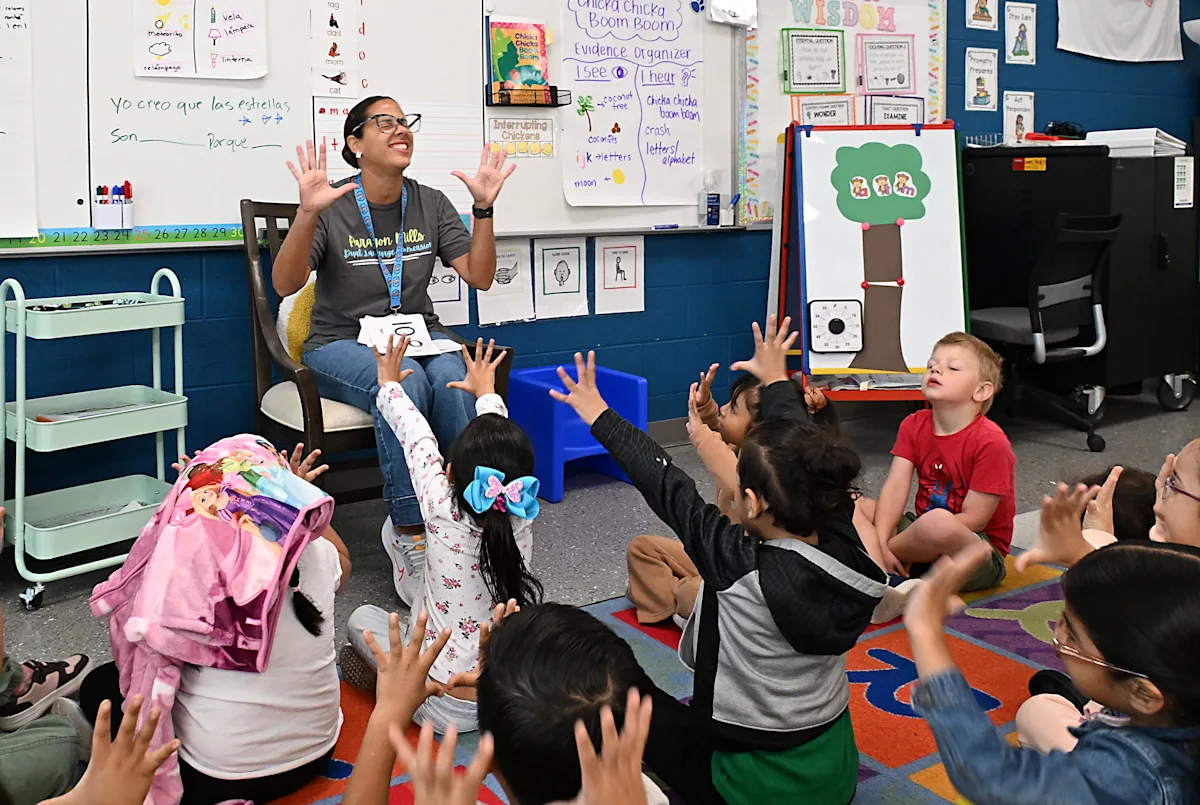
The kindergarten students sit in pairs, sharing small piles of books, or libros, as they work out the answer to a math equation in Spanish.
Many of the students already speak Spanish at home. Some of them are new to it, as English is their first language.
And it works the other way, too.
These students are some of the first in the district’s Dual Language Immersion program, in which students learn both English and Spanish by receiving instruction in each for 50 percent of every school day.
Glenview, Paragon Mills, and Stratton elementary schools implemented dual language immersion programs in 2025 through a federal Magnet Schools Assistance Program (MSAP) grant. The approach creates a foundation for them to become bilingual and biliterate at an early age.
Each school started its program with kindergarten students in 2025-26, added first grade students this school year, and will continue to add a grade a year until all K-5 students are learning in both English and Spanish every day.
“Even though we are still early in our journey, I can already see the impact,” Paragon Mills Principal Andy Lyons said. “Our students are developing confidence using two languages, learning from one another, and building an appreciation for cultures and perspectives beyond their own. It is exciting to walk into our Dual Language classrooms and see students communicating, collaborating, and learning academic content in both English and Spanish.”
The benefits of bilingualism are well known: being able to communicate in more ways to more people; gaining a better understanding of why a language works the way it does; a stronger ability to focus; enhanced multitasking skills; better memory; being better equipped for an increasingly diverse and multilingual world, and much more.

“Being able to transfer decoding skills and use vocabulary in the correct way are just some examples of the skills a bilingual person can access,” said Angela Perez, who teaches first grade in Spanish at Paragon Mills. “And from a cultural standpoint, it is always a positive to promote diversity and difference of opinions.”
Making Connections Between Languages
At Paragon Mills, students learn math and science in Spanish and learn English Language Arts and social studies in English, switching from one language to the other around midday. On a recent morning, Nydia Torres led her kindergarten math class in Spanish, occasionally dropping in a phrase or two in English, like “criss-cross applesauce” when she needed students to sit with their legs crossed while in a large group on the floor.
The 17 students recited numbers Torres showed on flash cards, from uno to diez, and worked on math problems in pairs, sometimes using markers and blocks as they counted. Torres, who has been with the district for three years and served as a math tutor and classroom associate before she started teaching, was animated and frequently on the move throughout the class period.
“A young child’s mind is like a sponge,” she said later. “It’s incredible how well they can absorb new languages and their concepts. At such a young age, they can make connections between languages, looking for differences and similarities. I would say that one language reinforces the other.”
Meanwhile, Perez and her first grade class worked through “problemas de comparacion,” or comparison problems, by considering a pair of girls and the white (blanco) and chocolate cupcakes they ate. Perez occasionally sat with the students on the floor and passed around a microphone to make sure everyone could hear each other.
“I think the students have been adapting positively to the program,” said Perez, who has taught in the district since 2015. “They have the space to practice their second language, knowing that they are exposed to it outside of the classroom, too. And exposing them to it at such a young age allows them to tap into that curiosity and experimentation in order for them to practice it more feely.”
Lyons said the program is preparing students for “an increasingly global world” while also bolstering pride within the Paragon Mills community.
“For many of our families, their home language and culture are not simply being acknowledged – they are being elevated as important parts of the learning experience. At the same time, students who are learning Spanish are being given an opportunity that can open doors for them academically, socially, and professionally in the future.”
