


NASHVILLE — Tennessee lawmakers approved a new U.S. congressional map Thursday after days of debate, protests inside the State Capitol and sharp exchanges on the House and Senate floors over a proposal that divides the state’s lone majority-Black congressional district in Memphis.
The Republican-led Legislature passed the measure during a special session called by Gov. Bill Lee following the U.S. Supreme Court’s April 29 voting rights ruling. The new map redraws Tennessee’s congressional boundaries ahead of the Aug. 6 primary election and divides the Memphis-based 9th Congressional District, currently represented by Steve Cohen, into three separate districts.
Presenting the proposal on the Senate floor, state Sen. John Stevens, a Huntingdon Republican, said the map was intended to reflect the state’s political makeup.
“Tennessee is a conservative state, and this map ensures that our congressional delegation reflects that,” Stevens said. “This is about allowing Tennessee to maximize its partisan advantage.”
Democratic lawmakers challenged that argument during floor debate, raising concerns about the impact on Black voters in Memphis.
“This map diminishes Memphis,” state Sen. London Lamar said during debate. “Racism doesn’t become less racist just because it’s called partisan.”
Senate Minority Leader Raumesh Akbari also urged lawmakers to reject the proposal.
“When you had an opportunity to do right, did you vote to make sure that those Black folks in Memphis who believe in this state, who pay their taxes, who work just like everyone else, have a right to be politically represented as well by folks who share their interest and who advocate for them on a federal level?” Akbari said during her floor speech.
As debate continued in the Senate chamber, state Sen. Charlane Oliver, a Nashville Democrat, stood on top of her desk and sang in protest of the measure before the final vote. Later, Oliver wrote on social media: “Today, the GOP tried to bury Black voices, but they woke up a movement. The PEOPLE united will never be divided. Tennessee is the new battleground.”
In the House, Speaker Cameron Sexton said the map was based on political and population data.
“No racial data was used,” Sexton said during earlier debate on the proposal.
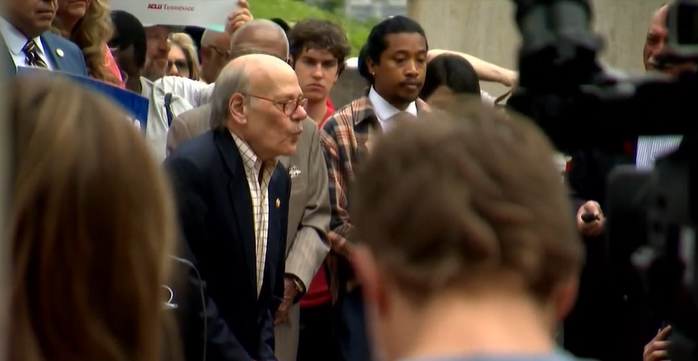
The legislative debate unfolded amid demonstrations throughout the week as hundreds of protesters filled hallways, committee rooms and public galleries. During House proceedings, chants and shouts from the gallery interrupted debate, prompting lawmakers to move forward with the vote as Democratic members stood and walked out of the chamber.
In the Senate, protesters could be heard outside the chamber during debate. In a separate act of protest, state Rep. Justin Jones walked out of the House chamber and later burned a photograph of a Confederate flag.
Outside the chambers, Tequila Johnson addressed demonstrators gathered at the Capitol.
“They don’t want to see us win, so they cheat,” Johnson said. “Don’t get it twisted, this isn’t new.”
Lawmakers also repealed a state law that had previously restricted congressional redistricting to once every 10 years following the U.S. Census, allowing the mid-decade redraw to move forward. Opponents of the map have said legal challenges are expected.
