



By Cassandra Stephenson, Anita Wadhwani, Sam Stockard and Adam Friedman
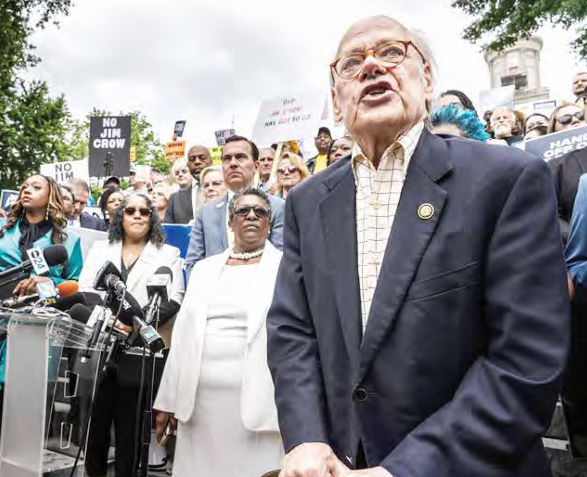
MEMPHIS, TN — Democratic U.S. Rep. Steve Cohen will not run for reelection in any of the three gerrymandered districts that now include Memphis after the Tennessee Legislature passed a new map last week, splitting up the region he served for more than 19 years.
“Last week, Tennessee Republicans silenced the Black vote here in Memphis to make Republican victories likely,” Cohen wrote in a statement Friday. “We are still fighting, and if we prevail in the courts and the 9th District remains intact, I will remain a candidate and will be proud to represent you for another two years.”
Cohen is a plaintiff in a federal lawsuit arguing that allowing the new district map to remain in effect for the 2026 U.S. House election will cause chaos and confusion for voters. U.S. District Court Judge William Campbell, a President Donald Trump appointee, denied a temporary restraining order in the case on Thursday.
Cohen told reporters assembled in his D.C. office on Friday that he is “not a quitter” and did not want to quit, “but these districts were drawn to beat me,” The Associated Press reported.
“My main focus is Memphis, and I don’t think I can do that in those districts that could stretch all the way up to Williamson County. It would be difficult for anyone to represent those districts,” he said. “Memphis should have a compact district. But that’s part of it … those districts just don’t make any sense.”
“I just thought it was an uphill battle, and it would be physically demanding, and it would probably be a dirty campaign.”
Still, he said, “if the district plan is struck down, I will run for the seat I filed for and served for 19 years.”
The Tennessee General Assembly’s Republican supermajority passed the new district map last week after a whirlwind special legislative session called by Gov. Bill Lee at Trump’s instruction. Lawmakers also passed new rules for the 2026 U.S. House election setting a May 15 deadline for candidates to qualify, cement which district they are running in or bow out of the race. Campaigns for U.S. House seats were already underway before the special session, which happened weeks after the election’s original March 10 qualifying deadline.
Cohen started his political career in the Tennessee Senate, winning a seat in 1982 and holding it until his move to Congress in 2007. He will have served two decades in Congress when his 10th term ends at the start of next year.
“I thought this would be the last, one more term,” Cohen said. “I thought about retiring earlier, but a lot of people in Memphis came to me and said ‘We need you in Congress because you’re so effective in bringing Memphis community projects and you’ve got your seniority where you’ll be a lead person in the fight to oversee Trump.’ And I thought that would be something to do.
Cohen anticipated a Supreme Court decision that would usher in a gerrymandered district, he said. But not so soon.
In Congress, Cohen is known as one of the more progressive members of the Democratic Caucus and a strong opponent of Trump.
Cohen’s seat has always represented the entire city of Memphis in a minority-majority district. He first ran for the seat in 1996, losing in the primary to Harold Ford Jr.
After a competitive 2006 victory, Cohen faced little opposition in future elections until this year. Initially, he was set to face a primary challenge this year from state Rep. Justin Pearson.
The new 9th District only includes a sliver of Memphis, with the new district lines drawn across Tennessee connecting it with Nashville suburbs in Williamson County. Other parts of the city are now split between District 5 and District 8, each containing several rural West Tennessee counties.
Cohen is best known for passing the constitutional amendment in the Tennessee Legislature creating the lottery, which has provided hundreds of millions of dollars for college students to pay tuition. He also expressed pride in bringing in federal funding for construction of a new bridge across the Mississippi River, from Memphis to Arkansas, and creating a license plate program to fund the state’s arts program, in addition to passing animal rights and civil rights legislation in Congress.
