



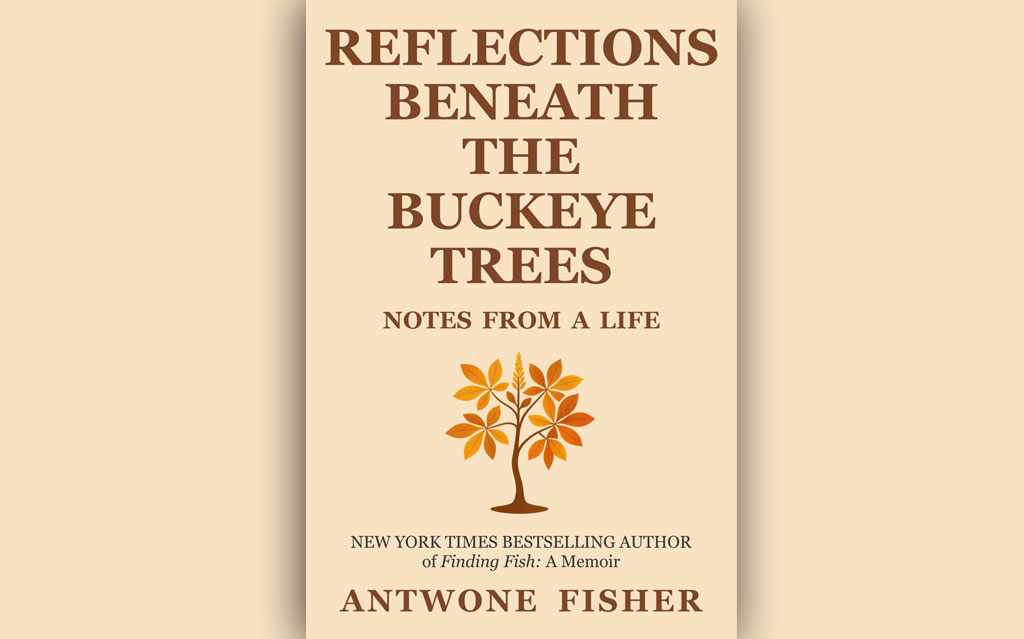
More than 20 years after his New York Times bestselling memoir Finding Fish, acclaimed screenwriter Antwone Fisher has written another book that’s getting early praise before its official release in April. Reflections Beneath the Buckeye Trees comprises more than 130 reflections that Fisher describes as “a gathering of memory – of truth as I lived it.” The reflections include growing up in the foster system, being bullied, experiencing the Deep South for the first time, and the making of his film, “Antwone Fisher (2002),” which was directed by the iconic Denzel Washington, whose guidance and friendship Fisher reflects upon in the book.
“This is a powerful collection of unforgettable essays that introduce, present, and carry the reader along through Antwone Fisher’s remarkable life, a journey on which together we meet a series of wonderful individuals – these personal accounts are as arresting as they are beautiful,” said Elijah Anderson, Sterling Professor of Sociology at Yale University. “By the end, we feel as though we know Antwone.”
Fisher talked about the book in a recent interview:
What inspired you to write Reflections Beneath the Buckeye Trees?
Fisher: After more than twenty years, I realized that memory itself had become my responsibility. I wasn’t just living life anymore, I was carrying it. The people, the streets, the lessons, the losses – they were all still alive inside me. I felt a quiet urgency to honor them before time softened their edges. This book came from a desire to preserve what shaped me, not as history, but as lived truth.
Were some entries especially hard to write?
Fisher: Yes. Many of them were difficult because writing them meant standing again in moments I had learned to survive by walking past. Some memories were tender. Others were painful. But I learned that avoiding them didn’t protect me, it just delayed healing. Writing became a way of telling my younger self, “You made it through. Your story matters.”
You talk about a bully named “Tyrone.” Is that a reflection of forgiveness?
Fisher: Very much so. When I saw Tyrone years later while I was filming Antwone Fisher in Cleveland, Ohio, he was remorseful for how he’d treated me as a kid. I forgave him. But there was another bully from the past that I also encountered during the filming. James had robbed me when I was a kid. He came up to me trying to intimidate me, denying what he had done, even threatening me. He hadn’t changed. He was still trying to bully me. So, I treated them differently. Tyrone came with humility. James came with aggression. I was old enough by then to read that, to discern. Forgiveness doesn’t mean pretending people haven’t hurt you. It means responding to who they are now. Tyrone showed growth. James didn’t. So, with Tyrone, I offered grace. With James, I held my ground. And that’s something life teaches you: compassion doesn’t mean being naïve. It means being clear.
You speak glowingly about producer Todd Black and Denzel Washington. Particularly with Todd Black, he coached you as you wrote the screenplay for Antwone Fisher. Are there other “Todd Blacks” in Hollywood today, ones that give the kind of attention he did?
Fisher: There are, but they’re rare. Todd didn’t just open a door—he stood in the doorway with me. He gave time, attention, and belief. That’s priceless. For an aspiring writer, a few sincere minutes from someone who truly sees you can change your entire trajectory. It says: “You’re not invisible.”
Did Todd and Denzel’s support influence your work with students?
Fisher: Absolutely. When someone invests in you, it creates a responsibility to pass that forward. I saw what encouragement could do in my own life. So, when I’m with students, I’m not just teaching craft, I’m offering permission. Permission to believe they belong in the room.
What advice would you give aspiring storytellers?
Fisher: Tell the truth first. Technique can be learned. Honesty cannot. Don’t write to impress, write to reveal. Protect your voice. Study your craft. Be patient. And remember: your life is already material. You don’t need to invent meaning. It’s there, waiting.
If you could speak to your younger self, what would you tell the little boy who grew up in the foster system?
Fisher: I would tell him: “You are not forgotten. You are not disposable. None of this is your fault. One day, your voice will travel further than your fear. And the very things that hurt you now will become the source of your strength.”
To learn more about Antwone Fisher and order his latest book now, visit: https://glenvillehousepress.com/
