



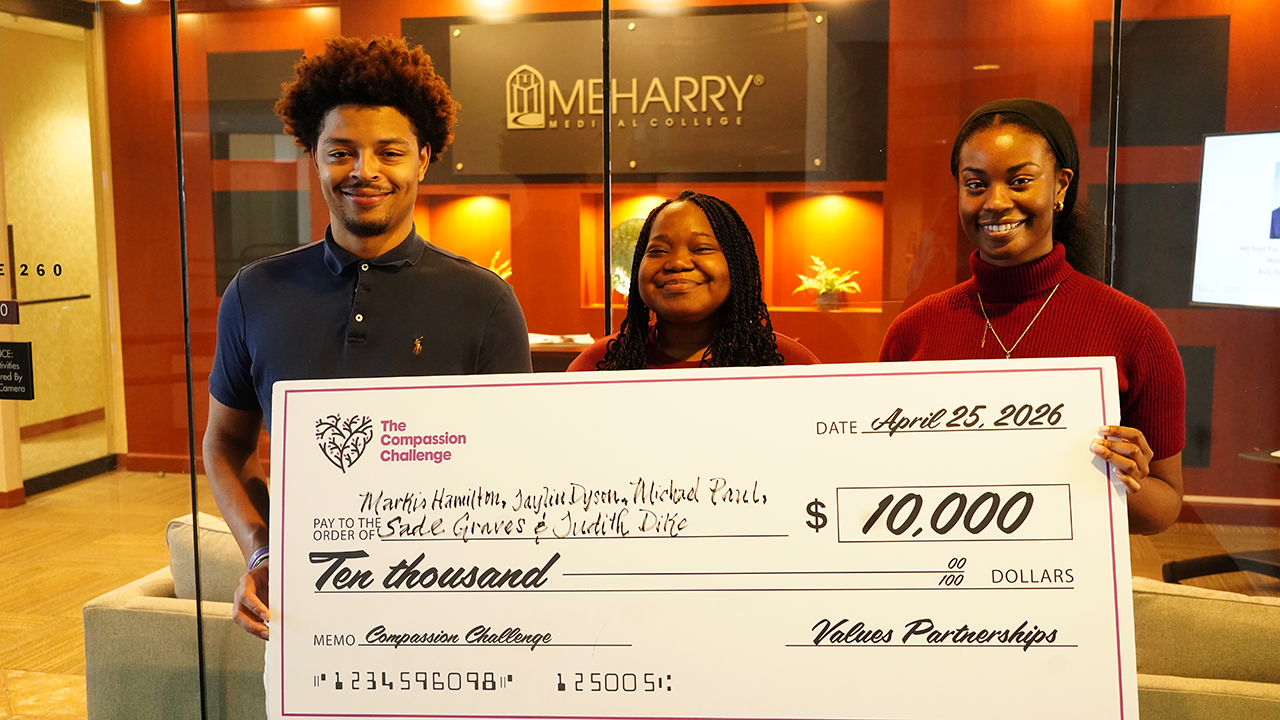
A team of Meharry Medical College students has introduced a solution showing that urban development can thrive without displacing community residents. Their plan received the first-place prize — and $10,000 — in the Compassion Challenge, a national HBCU competition hosted by We Are Values, the Robert Wood Johnson Foundation and CALPE Labs.
The Challenge asked student teams to solve the problem of “green gentrification,” the pattern where park and greenspace investments in historically under-resourced neighborhoods inadvertently raise property values, displace longtime residents, and deepen racial and economic inequality, ultimately harming the very communities the investments were meant to help.
The Meharry team tackled this problem by examining the planned $56.7 million Durham-to-Roxboro Rail Trail in North Carolina. The proposed trail presents new concerns about displacement for Hayti, a predominantly Black neighborhood near Durham that was once known as a thriving center of entrepreneurship and culture. The area originally included more than 200 Black-owned businesses, including banks, insurance companies and theaters. In the 1960s, urban renewal disrupted its physical landscape as construction for the Durham Freeway decimated many of its homes and businesses.
The Meharry team included Jaylin Dyson, Judith Dike, Michael Paul and Sade Graves from the School of Applied Computational Sciences and Markis’ Hamilton from the School of Graduate Studies. Together, they examined the planned rail trail with a task to develop a win-win solution centered on compassion that promotes healthy green spaces and environmental health while generating competitive financial returns for both residents and developers.
“The challenge was an interesting opportunity that isn’t directly related to biology or clinical applications of data science,” said Dyson.
“It was a pleasure working alongside the team to tackle a real-life problem that often goes unnoticed unless you have to face it head-on,” said Hamilton.
Diving Into Data and History
The team explored similar developments in other cities, most notably the Atlanta Beltline — a 22-mile loop of trails, parks and mixed-use development built on a former railway corridor around Atlanta’s urban core. Funded through bonds to be paid by future, higher property taxes, the Beltline’s unintended result was significant resident displacement, serving as a cautionary case study for future efforts.
“We looked at Atlanta through the lens of how Hayti can have a similar financial success without displacing its residents,” said Dyson.
“Each week we would pick three issues to explore, dividing responsibilities so that we can balance the project with our studies,” said Dike. The team then examined Hayti and North Carolina census data and several legal studies.
“The legal studies were not something in our wheelhouse, but we had to discover what could legally be done and not be done,” said Dyson.
They also sought out first-person accounts of Hayti’s history to understand how building an interstate in the middle of the once-prosperous neighborhood originally damaged the community economically. A community elder and historian shared the community’s feelings about the trail development, especially with the context of its history.
The Meharry Solution
The Meharry team’s winning solution focuses on creating an endowment to invest in the community before the development raises property values. The fund includes a deep reserve that provides an emergency cushion and intergenerational growth that serves as a permanent investment to fund the model.
“We identified funding sources from the state pension fund, bank investments, grants and philanthropy,” said Dyson. “We believe the development will drive more growth, but we had to find a financial model that made sure the residents would also benefit. So we freeze property taxes on seniors and use the money generated by the endowment to support residents so that they aren’t forced to leave.”
“I believe this part of the proposal resonated with many people because it created a sense of inclusion and ensured that community members had a seat at the table to discuss how proposed changes would benefit them and future generations,” said Hamilton.
That community voice is provided through the proposed Co-Governance Board.

“In addition to the Community Investment Trust, the Co-Governance Board is one of the most important components of our proposal,” said Paul. “Often when urban development happens in neighborhoods like Hayti, the local inhabitants get no stake or equity in the profits generated from the new development. Also, residents typically have no say or vote on the type of developments that are approved in their area.”
The Data Science Advantage
The team believes their data science background gave them a significant competitive edge. They developed a displacement prevention algorithm that supports proactive outreach to identify residents at risk of displacement before an eviction.
“With our data science background, we understand how to predict outcomes from data, which the judges found very interesting,” Dyson said. “For example, our displacement algorithm can predict displacement at the individual level before it happens.”
“And the dashboard we created makes it easy to track displacement on the individual, neighborhood and city level and compare it to other cities and states,” said Dike. “With annual updates, we can not only track displacement, but also the financial impact on households in the neighborhood.”
Health Care Impact
Ultimately, the team believes the plan will have a massive impact on health outcomes for Hayti.
Hamilton noted that the project highlights how protecting a community’s economic health directly safeguards its physical health.
“This project highlights the importance of community-driven efforts to create positive change in public health by advocating for economic growth and improving essential services,” said Hamilton.
“Hayti doesn’t really have a grocery store or a hospital on their side of the freeway,” said Dike. “When you consider social determinants of health, if they enact this plan, it would really improve health outcomes, not just for today’s residents, but future generations.”
“From my perspective, if you make a community wealthier, then all those things will come,” said Dyson. “So, if you build wealth in the community, which our plan does, then those quality-of-life things will follow.”
“Also, by being members of a Co-Governance Board, residents will have a say in developments that may benefit their health,” said Paul. “For example, if there is a park within walking distance, data shows that you are more likely to go to the park, walk around and exercise. Research shows that the buildings and structures in your neighborhood have a direct correlation with your health.”
Looking at Future Displacement
The team’s proposal might even lead to an opportunity to influence future development for the Atlanta Beltline.
“Jaylin, Sade, and I are going to Atlanta to meet a group that includes one of the biggest Black developers in the city,” said Dike.
“We are going to meet with him about the final phase of the Beltline,” said Dyson. “He’s very serious about avoiding displacement with this section.”
The Compassion Challenge has also sparked an interest in similar work in the future.
“Displacement is a real thing happening all over the country. I have seen it happen in my hometown of Miami, Florida, and I am watching it happen in different parts of Nashville,” said Paul. “The challenge helped me realize that I can use my knowledge to help communities right now. I don’t have to wait for graduation to make an impact. I can make a real impact today.”
“The history and identity of these communities are worth protecting because they provide residents with a strong sense of belonging and connection to their roots,” added Hamilton. “Preserving and investing in these neighborhoods also honors the generations of families who lived and built their lives there, while empowering current and future residents to thrive in the same spaces.”
