



By Genma Holmes
According to the 2025 Economic Report to the Governor of the State of Tennessee, prepared by the Boyd Center for Business and Economic Research at UT’s Haslam School of Business, “The state’s agricultural and forestry industries directly and indirectly contributed $103 billion to the Tennessee economy,” says Andrew Muhammad, UTIA professor of agricultural economics.
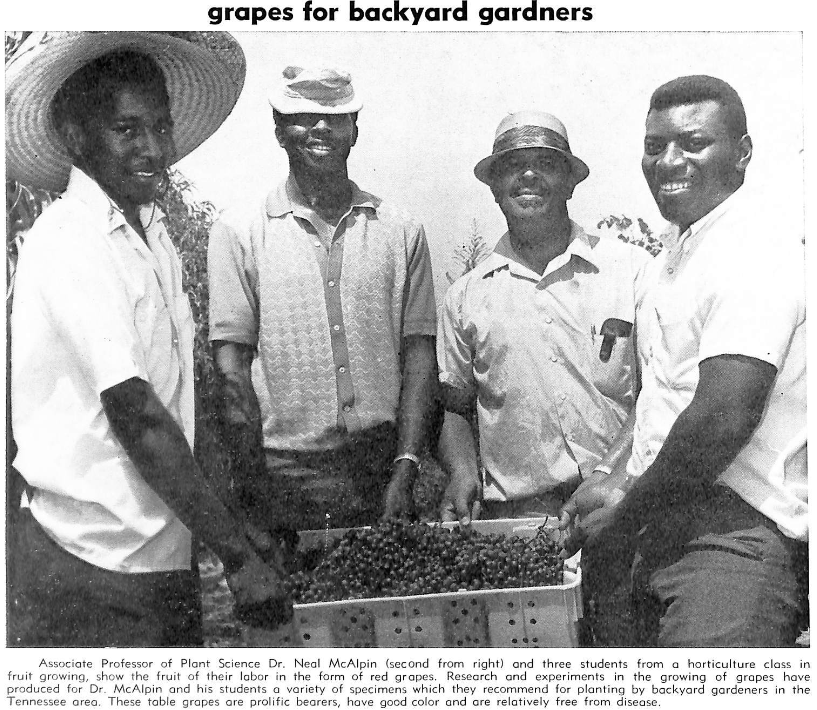
Decades before the annual reports were provided to Tennessee governors, Dr. Neal McAlpin, Sr., understood how the state’s agriculture influenced its economy from the ground up. McAlpin was a respected researcher, plant scientist, and horticulture specialist who taught at Tennessee State University from 1943 until he retired in 1980. He showed how agriculture supported Tennessee’s economy and the well-being of both urban and rural communities. His in-depth research on peaches and his work developing new varieties of flowers, such as orchids, roses, and chrysanthemums, made him a popular speaker at think tanks, universities, horticulture conferences, and gardening shows across the country.
Born on May 30, 1914, to Cora Belle Roddy McAlpin and Ivy Brandford McAlpin, Sr., McAlpin grew up in Dayton, Tennessee, where his love for horticulture began humbly as a young boy, climbing peach trees in his family’s home orchard. He shared with the Tennessean’s Hal Herd in 1970 that after causing the peach trees to split from climbing in them to pick the fruit, “We tied the limbs back to the trunk to keep my mother from finding out. It was interesting to learn the limbs would soon grow back to the trees.” Those encounters with trees healing themselves from injuries grew into an educational interest nurtured at home. In the Jim Crow South, his parents allowed him to attend events such as forestry training in 1933 while still in high school. This was not an adventure often offered to families of color. While in high school, he also contributed to the Chicago Defender and other newspapers. He covered social events, comings and goings in Dayton, Tennessee, and the surrounding areas, as well as African-American issues. After graduating valedictorian and class president from Dayton High School in 1936, McAlpin attended Tennessee State University, known then as Tennessee A & I State College.
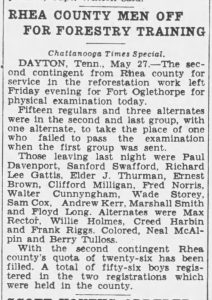 Chattanooga Daily Times, 1933
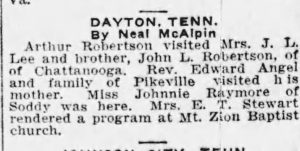
When he left the small town of Dayton, he was equipped beyond his years to attend college. McAlpin brought with him a love of learning and his passion for peaches, which served him well as he progressed meritoriously through college. He graduated with distinction with a B.S. in Agriculture and, soon after, he began teaching at his alma mater in 1941. In 1940, he married his college sweetheart, Ruth Francis Duvall from Hot Springs, Arkansas. Together, they became a power couple known not only in Nashville but nationally until her passing in 1972.
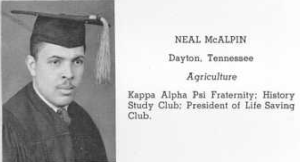 The Ayeni Yearbook, 1941
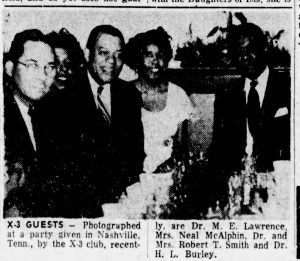 The Afro American, 1953
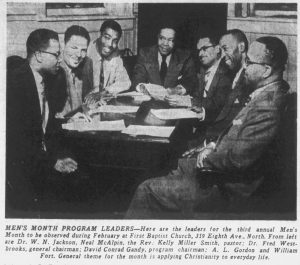 Nashville Banner, 1956
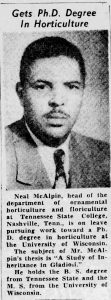
After marrying Ruth and joining the faculty, he was employed for only a short time before pursuing further study and earning his master’s degree in horticulture from the University of Wisconsin-Madison. His leaving to pursue his master’s degree was newsworthy at the time. He returned a few years later to pursue his doctorate in horticulture and botany at Rutgers University in 1958, and the school, once again, touted his accomplishment. A lifelong learner and born leader, few horticulturists have demonstrated the devotion to improving the gardening experience for everyday people as consistently as McAlpin. He believed beautiful, healthy plants should not be a luxury reserved for a select few. Instead, he worked toward a vision where homeowners from every socioeconomic background could enjoy successful gardens and landscapes.
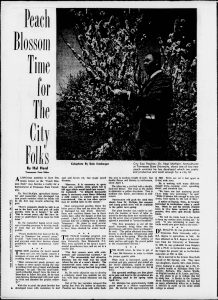
Dr. McAlpin believed Tennessee could become the “Peach Blossom State,” according to numerous media statements. He aimed to make his childhood peach-picking experiences possible for urban youth during his horticultural career. He wanted them to be able to walk outside to grab a peach from a tree, despite the smaller lots on which homes were being built. He also focused on community health. By growing their own food, McAlpin knew families would improve their health outcomes, and individuals would live longer, healthier lives. An environmentalist and conservationist before those words became part of our lexicon, McAlpin recycled cans and egg cartons long before it was trendy. Recycling food and goods saved money; money saved could move urban families from being consumers to producers. He did not stay in the classroom; he was not comfortable with the complications of town and gown. He took the classroom to the people. He taught rural communities how to improve farm output by introducing more advanced techniques to enhance disease resistance. Fewer diseases and pests meant more crops. More crops transform poor farmers barely making ends meet into financially stable businesses, business owners who contribute billions of dollars to the state’s economy.
He was a hands-on speaker and performed gardening demonstrations around the country and at TSU’s “Farm, Home, and Ministers Institute,” an annual event on campus that brought “leaders (federal, state, county, and community) to discuss ways and means and develop methods and techniques for improving the standard of living among rural and urban low-income and limited resource families in Tennessee.” Along with other leaders, McAlpin helped bring people to the institute from counties across the state. The annual event began in 1958, after Tennessee A & I was elevated to land-grant university status. Dr. Walter S. Davis was the President, and Dr. Walter A. Flowers was the first director of the Division of Extension and Field Service, organized the program.
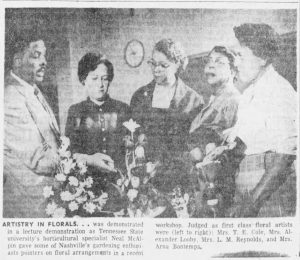
The Call, 1951
It was at this time that research in agriculture grew exponentially on the campus. McAlpin began breeding thousands of peach trees on 14 acres to develop varieties for consumers. He started with 400 trees in 1963 and grew the experimental farm to over 10,000 trees in under a decade. He introduced dwarf flowering varieties suitable for home fruit production and ornamental plants. Central to his work was the development and promotion of plants with improved disease resistance. By focusing on varieties better able to withstand common plant diseases, McAlpin reduced the problems experienced by home gardeners who may not have had access to expensive treatments, specialized equipment, or extensive horticultural knowledge. He preached the gospel of growing your own food, no matter where you lived.
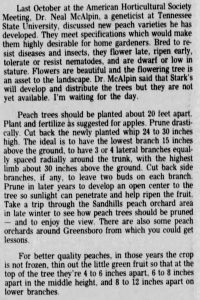
News and Record, 1979
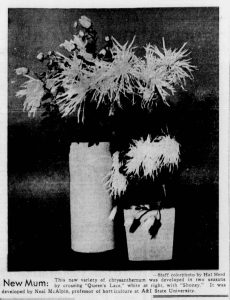
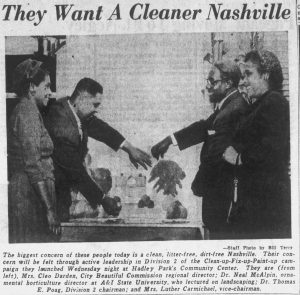
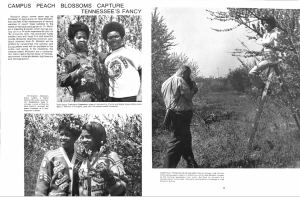
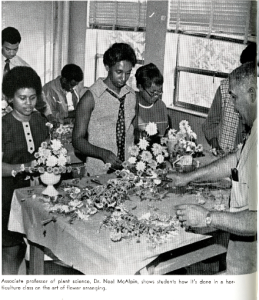
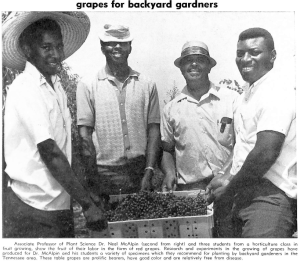
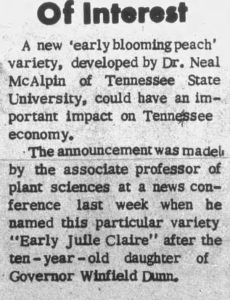
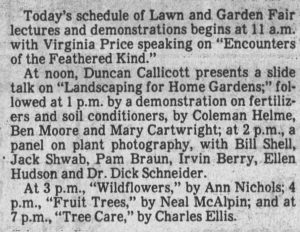
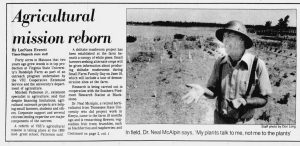
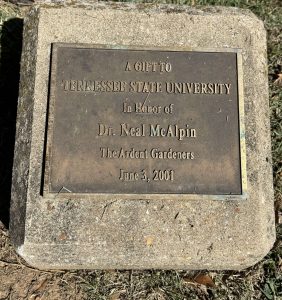
Photo Credit: Genma Holmes
Dr. McAlpin remarried later in life to Helen Harris. He was inducted into the Tennessee State University Agriculture and Home Economics Hall of Fame in 1997. A marker was dedicated in his honor in 2001 on campus. After his death in 2003, the School of Agriculture established a scholarship in his honor.
Copyright © 2026 Genma Holmes/GSH Media. All rights reserved.
