



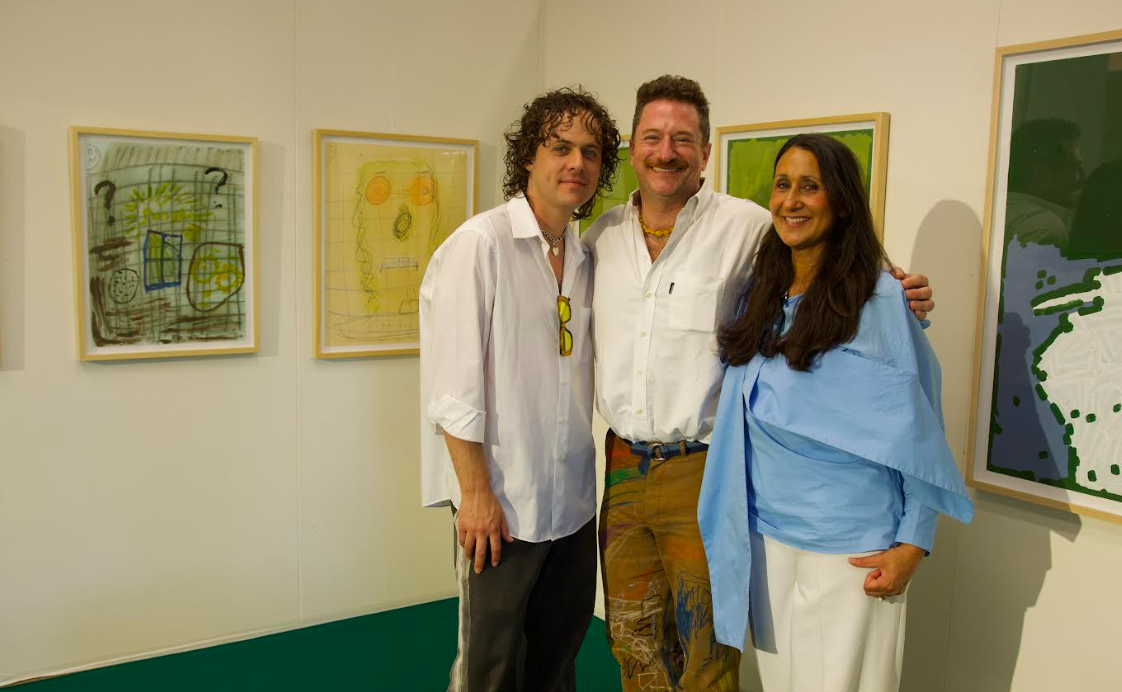
EDITOR’S NOTE: This is the first installment of a two-part series on the recent week-long global art fair in Basel, Switzerland, including an exhibition of artists with disabilities or mental health challenges.
BASEL, SWITZERLAND – During Art Basel week in Basel, Switzerland, citizens and visitors alike were feted with a smorgasbord of artwork from a roster of artists and galleries from around the world.
While the artwork from artists of national and international repute graced the walls and display partitions at Art Basel’s three event halls, another exhibition of note was on display at the Franck Areal in Basel, an open public exhibition space just a mere 15 minutes away.
“Living Museum x Open Invitational,” the exhibition at the Franck Areal, comprised the artwork of artists concurrent with Art Basel week June 15-20 — artists who’re regarded less than practicing artists in the art world due to a disability or mental illness.
The exhibition, however, was replete with an array of paintings, drawings, and other modes of expression on two levels: artwork on the lower level representing Living Museums from several countries and artwork on the level above from several progressive art studios participating in the Open Invitational.
The first Living Museum was founded in 1983 by Dr. Janos Marton, a Hungarian artist and psychologist, and Bolek Greczynski, a Polish artist. The concept is rooted in psychiatry to help individuals facing mental health challenges.
Hosted in Basel by the Living Museum Society, there are now over 40 Living Museums in 10 countries. It is a global social arts movement and a transformative therapy program that increases visibility and cultural inclusion.
Lilly Manger, a mental health nurse, cofounded Living Museum Basel. “This is something that we needed in Basel,” said Manger, who was sold on the concept after visiting a Living Museum in New York.
There are 17 Living Museums alone in Switzerland. “This is mushrooming in the most beautiful way,” she said.
David Fierman, a New York-based dealer and gallerist, who, along with Ross McCalla, cofounded Open Studio and the nonprofit Open Invitational in 2024 to “broaden public awareness of progressive art studios.”
Basel is their first art fair in partnership with the Living Museum Society. “This is the biggest global art event on the annual calendar,” Fierman said. “We’re excited to bring the artists to the forefront of visibility in the art world.”
Raquel Guenat, a designer, art educator, art mediator, and board member of the Living Museum Society, first started working with Fierman and McCalla in Miami and talked about exhibiting in Basel.
“We started looking around to make this happen to provide opportunities for artists to show their work,” Guenat said.
Artists with disabilities now have a platform to present their artwork. Hop Peternell, Lydia Glenn-Murray and Kathleen Henderson, who run Studio Route 29, a 501c3 nonprofit progressive art studio in Frenchtown, NJ., seek to transform their artists into bona fide creatives.
Peternell said at least 45 artists work at Studio Route 29. He brought to Basel new artwork by Brian Armour Jr. and Michael Angelo Mangino, two standouts who have attracted widespread attention.
Both Armour and Mangino have been with Studio Route 29 since the early days per se. Their artwork, however, differ in style, technique, and subject matter.
“BJ is such a storyteller,” Peternell said. “The drawings are notated and there’s a lot of language. It symbolizes something.”
While dreams and time travel are often a part of the work that Armour creates, Mangino, who is non-verbal, prefers working with colorful, flat shapes that are juxtaposed against each other.
“He’s drawn to abstract painting,” Peternell said of Mangino, and added that he learns a lot from the artists he works with.
Copyright 2026 TNTRIBUNE. All rights reserved.
