



Nashville, TN – As Tennessee and other states organize for the 2026 midterm elections, voting rights and similar protections guaranteed under the federal Civil Rights Acts are under attack. President Donald Trump began threatening to disrupt and intimidate election officials last week, warning he might nationalize elections in certain cities, though the U.S. Constitution still makes clear that states run elections. On the other hand, the fight to protect voting rights for American citizens has never stopped.
As they’ve been doing for fifteen years, Davidson County Criminal Court Clerk Howard Gentry and General Sessions Court Judge Rachel Bell continue to team up and provide legal restoration clinics, where a person can get their voting rights restored after satisfying restitution for a non-violent felony.
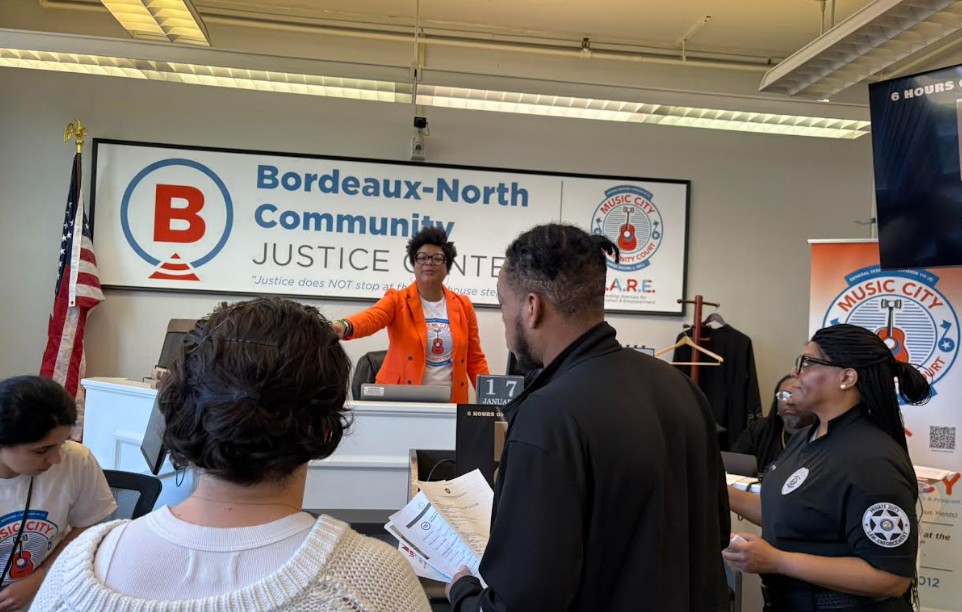
Judge Bell presides over a specialty court called General Sessions Music City Community Court. She founded the court in partnership with Criminal Court Clerk Gentry’s Office.
Individuals seeking to get voting rights stored, court cost-waivers, or record expungements can request to get on Bell’s General Sessions docket any weekday in the A.A. Birch Courthouse downtown. Or, they can choose to go to a Saturday session in North Nashville, where the Music City Community Court is housed, inside the McGruder Family Resource Center, 2013 25 th Ave., N. Bell convenes Saturday court there about every six weeks. The next Saturday session is scheduled for April 18th. Community court on Saturdays is held as part of larger Legal Restoration Clinic and Resource Fair. While restorative justice court is in session upstairs, the Resource Fair plays out downstairs with uplifting music and clinic registrants interacting with staff from agencies, such as the Public Defenders Office.
The annual Martin Luther King Legal Restoration Clinic, held Saturday, Jan. 17 th at Music City Community Court, drew more than 300 registrants inside McGruder Center, where parking is free. Vendors at the Resource Fair included the Vanderbilt University Law School Community Justice Project and career training programs, such as ITWORKS and UPRISE. Members of the Music City Chapter of The Links, Inc. were there offering voter registration lookups and giving out donated cleaning products. The Resource Fair serves as a one-stop center for services that would otherwise require visiting several different offices and locations.
“We’re only able to directly serve those who have cases in Davidson County,” Criminal Court Clerk Gentry told registrants, as they waited downstairs for the judge to hear their requests. “If your case is not in Davidson County, we can provide the information you need to access similar services in another county.”
According to the Sentencing Project, almost half-a-million Tennesseans are barred from voting because of a felony conviction. Tennessee is the second most restrictive state in the nation on restoring voting rights for felons. Getting a clean slate for some requires petitioning the governor, or the even U.S. president for a pardon.
“I’ve seen it done,” said Judge Bell. “I’ve seen President Trump’s name on one of our friend’s documents getting him pardoned and his record cleared,” she said, adding that she’s also seen the signatures of Governor Bill Lee and Presidents Biden and Clinton on pardons.
Ron Sisney, who got his voting rights restored back in 2008 when the process was less complicated, says the time he put in was well spent. “I now have a voice and my voice needs to be heard,” he said.
Sisney has since co-founded “My Father’s House Nashville,” a state certified, non-profit that assists men of color with re-entry and finding avenues to become productive members of society.
