


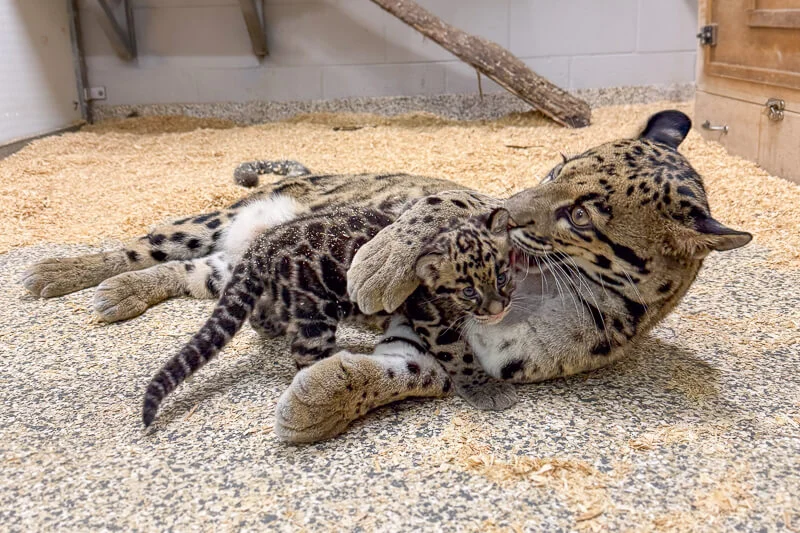

Nashville Zoo is proud to announce the birth of a second female clouded leopard cub born this year. Born on May 5, the cub is currently the size of a loaf of bread, weighing a little over two pounds. This birth marks the first time Nashville Zoo has partnered with the Association of Zoos and Aquariums (AZA)’s Species Survival Plan (SSP) to co-rear a clouded leopard cub. The cub’s name is Mayuree and is the 51st clouded leopard born at Nashville Zoo since 1991, an impressive accomplishment and a nod to the Zoo’s clouded leopard conservation program.
This is the fourth cub to be born to parents Niran and Ron. After Niran received an ultrasound to confirm that she was carrying a cub, animal care staff closely monitored her via camera throughout the pregnancy and labor process. The cub was born without any issues and mom remained safe during the delivery. After the successful birth, animal care staff carefully observed Niran and her cub for the first 72 hours to ensure appropriate maternal bonding and nursing behaviors. Approximately one week later, the veterinary team conducted a neonatal examination to evaluate the cub’s health and development. After this exam, the team decided to let Niran raise the cub naturally with support from Zoo staff, marking the first time Nashville Zoo has successfully co-reared a clouded leopard cub.
Co-rearing combines the benefits of maternal rearing with the advantages of early human socialization. In this approach, the mother raises and nurses the cub, while animal care staff conduct socialization sessions from an early age. These early interactions help the cub become comfortable with human handling, which supports future husbandry practices, veterinary care, and breeding management.
“Clouded leopard reproduction and cub rearing are notoriously challenging, with high rates of parental predation or neglect, so cubs are frequently hand-reared, but because Niran is doing a wonderful job caring for Mayuree, we have been able to co-rear a clouded leopard cub until they are weaned for the first time in Zoo history,” said Nashville Zoo’s Director of Veterinary Services Heather Schwartz. “We are excited to progress in our care techniques and studies with clouded leopards with this new birth and thrilled to be able to increase the population of threatened clouded leopards.”


To ensure a successful co-rearing experience, when Mayuree was a week old, the Zoo’s animal care team began socialization sessions with the cub while Niran was provided enrichment and treats in her outdoor habitat. Over the course of the following weeks, the number of times the cub was socialized was increased as well as the duration of these sessions. These sessions help acclimate the cub to human handling, which is important for future husbandry, veterinary care, and breeding management. Niran will raise Mayuree until she is weaned, then the cub will be paired with a playmate and on view for the public.
Clouded leopards (Neofelis nebulosa) are native to the tropical lowlands of Southeast Asia in countries such as Nepal and Bangladesh. They are considered vulnerable to extinction according to the International Union for the Conservation of Nature (IUCN) due to deforestation, poaching, and pet trade. Precise data on clouded leopard population numbers is not known, but researchers estimate there are around 10,000 clouded leopards in the wild. Specific populations can be difficult to track, as the clouded leopard is among the rarest of the world’s cat species and one of the most elusive. The reduced number of pelts encountered at illegal markets and reduced sightings of clouded leopards by people within its range suggest the species is in decline.
Nashville Zoo is part of the Clouded Leopard Species Survival Plan ® and helps protect this species through collaborative breeding programs, assisted reproduction, advanced veterinary care and specialized husbandry techniques, becoming a leader in clouded leopard conservation.
The birth of this cub is now more important than ever, as the Zoo continues it’s fight to block the proposed data center. To support Nashville Zoo, we encourage the public to sign our petition by visiting www.change.org/p/nashville-zoo-says-no-to-proposed-data-center.
