


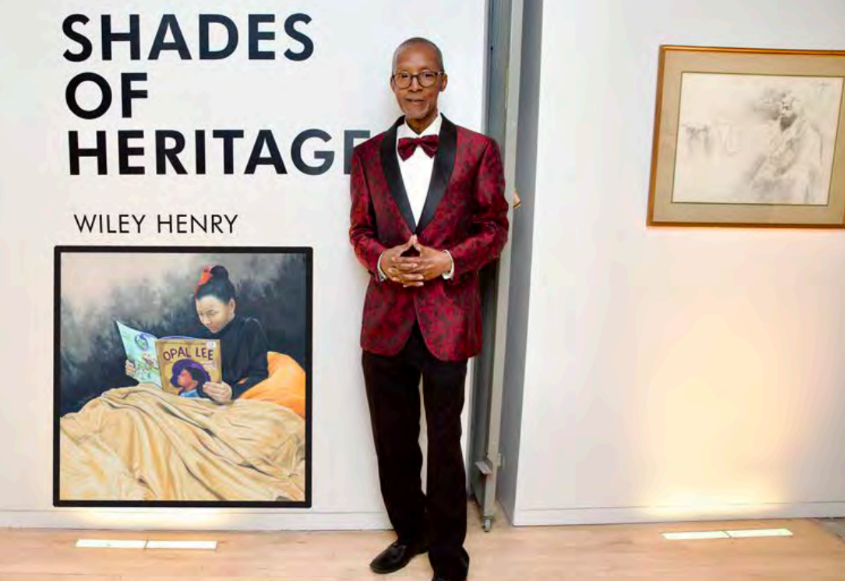
MEMPHIS, TN – For nearly a year, Wiley Henry, a contributing writer for The Tennessee Tribune and an award-winning journalist, worked in his home art studio to turn out 14 new oil paintings to add to the overall collection of 30 paintings and drawings that are now on exhibition in the East Gallery at Crosstown Arts in Memphis.
Titled “Shades of Heritage,” the journalist, author, photographer, and visual artist was greeted by an enthusiastic crowd of family, friends, and art enthusiasts who came out to support the artist during the opening of his art exhibition on Friday, March 13.
“I was on pins and needles before the opening of Shades of Heritage,” said Henry, who is reputed as a portrait artist and for his realistic and colorful renderings of African Americans in various settings. “But then, within a short period of time, I noticed the crowd had begun to swell. That’s when I realized I’d made an impact.”
In addition to Henry’s exhibition in the East Gallery, two other artists opened the same night: Lawrence Matthews, who is exhibiting fine art giclée prints in the West Gallery under the exhibit title “A Rabbit With a Gun,” is a fine photographer with a unique perspective; and Karl Erickson, whose digital animations and videos come alive in the screening room and along the pop-out walls, has an exhibition titled “Club Walrus, Fluvial Effluvia, and Know No Now.”
The exhibitions are open to the public and will hang through June 7.
“I’m proud of the work I’ve created in the East Gallery,” said Henry. “My intentions were to utilize the human form as subject matter and underscore the integral role of heritage within my artwork. It captivates me in ways that enable me to depict the human form on canvas or Strathmore paper with relative ease — for I am who I am because of my heritage.”
Henry said he wouldn’t be the artist that he is today if it had not been for his upbringing in a household with his parents and seven siblings, divine intervention, and the ordering of his footsteps.

“While this is not a religious exhibition,” he said, “I often find myself drawn to spiritual themes, occasionally depicting gatherings of Black angels and children in various celestial settings.”
History is another area that piques Henry’s intellectual curiosity. “I am particularly interested in representing pioneering Black men and women,” he said, “as well as other historical figures whose achievements have left lasting legacies and inspire future generations.”
This is a vital component of the artist’s artistic journey, which viewers will notice in paintings of noted historical individuals such as the Rev. William Barber, who is featured in the painting titled “Rev. William Barber: Back to Selma,” and the late Amelia Boynton Robinson, who was beaten on the Edmund Pettus Bridge in Selma, Ala., during “Bloody Sunday.” Her painting is aptly titled “Amelia Boynton Robinson: Back to Selma.”
In addition to the message that these two paintings convey, their size is just as compelling. Both paintings are 4 ft. x 4 ft. There are seven paintings of this size in the exhibition. Other sizes vary.
“I wanted to make an impact,” Henry said.
Copyright 2026 TNTRIBUNE. All rights reserved.
